

Carrying History
Walking through Munich with the past in my hands.

I have learned not to get excited when an email arrives from Willi.
For more than thirty years, our family has chased paintings that disappeared during the Holocaust. Every so often, another one surfaces. Most lead nowhere. There are archives to search, ownership to prove, lawyers to consult, and committees to persuade. Hope has learned to temper itself.
So when Willi wrote that an auction house in Munich had identified a painting that had once belonged to my grandfather’s gallery, I read the email with cautious optimism.
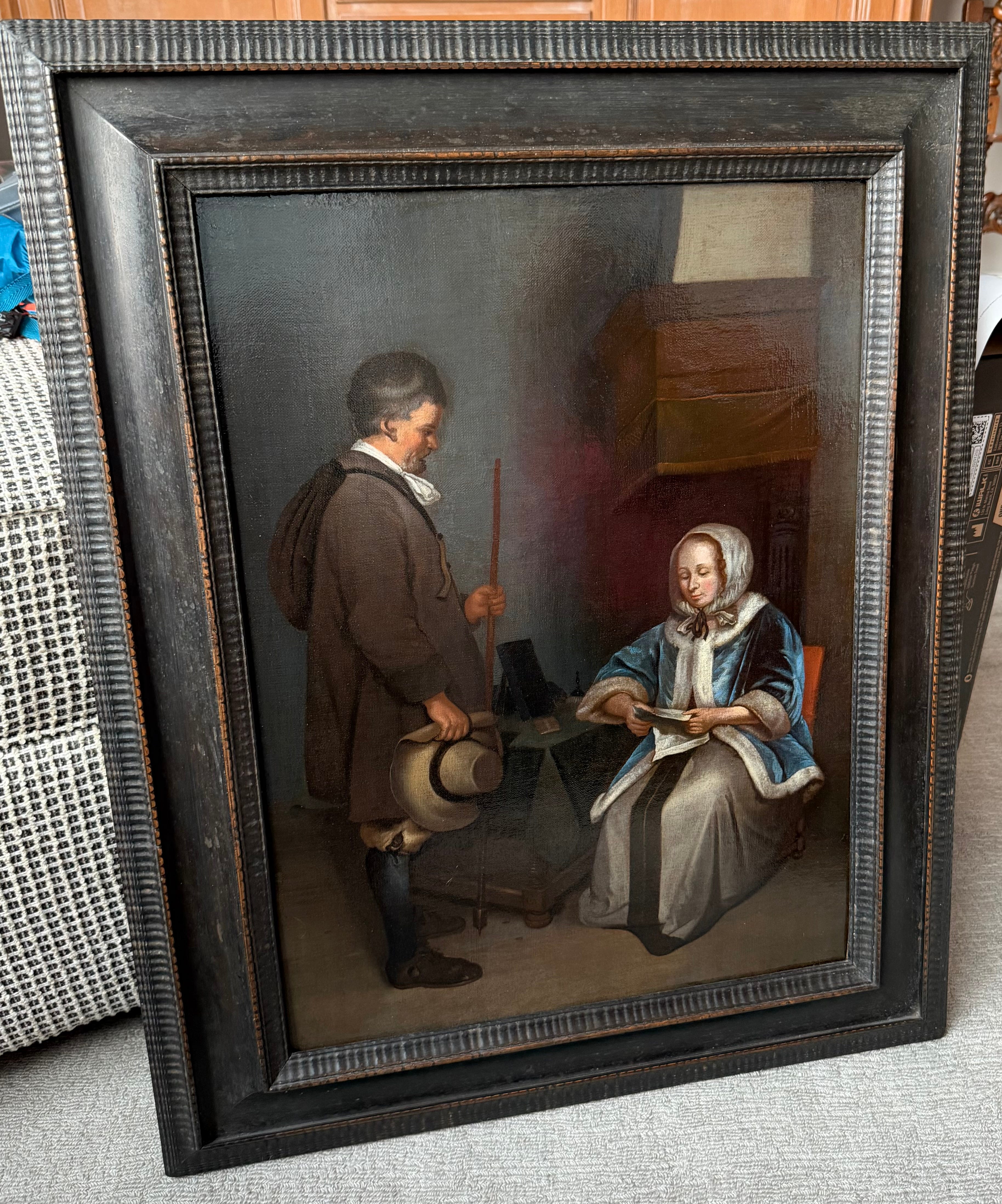
The painting had been consigned for sale by someone who had inherited it. As auction houses routinely do, they researched its provenance. That trail led back to August 1940, only months after Germany invaded the Netherlands, when my grandfather’s gallery sold hundreds of paintings to representatives working for Hitler.
Those sales have long been misunderstood.
They were never simply business transactions.
They were acts of survival.
My grandfather believed that by cooperating, his family and employees might be spared from the increasingly severe anti-Jewish decrees. More than six hundred paintings left the gallery during those years. Those paintings helped finance escapes, visas, and, ultimately, lives.
The painting failed to sell.
Its condition was poor, covered with decades of dirt and smoke. The owner agreed to return it to our family, and after it was professionally cleaned, Willi arranged for a friend to collect it, wrap it for travel, and leave it at my hotel in Munich before I even arrived.
Checking into the hotel felt strangely ordinary.
“I have something being held for me,” I told the receptionist, showing her a photograph of a claim ticket on my phone.
Moments later, she handed me a painting that had helped save my family.
I carried it upstairs, leaned it carefully inside the closet, and went about my stay as though nothing extraordinary had happened.
But everything about those two days felt extraordinary.
Each morning, I opened my curtains to find myself staring directly across the street at the Hofbräuhaus.
Not just another famous beer hall.
The place where Adolf Hitler announced the formation of the Nazi Party.
I found myself looking back and forth between the window and the closet.
Outside stood the birthplace of a movement that sought to erase my family.
Inside stood one small painting that had helped my family survive it.
The distance between them couldn’t have been more than a hundred yards.
At night, when tourists filled the square laughing and singing, I couldn’t help imagining another crowd.
Different voices.
Different songs.
Different cheers.
History has a way of refusing to stay in the past when you stand where it happened.
The next morning, I visited the Jewish Museum.
It is not a large museum.
There are no overwhelming displays.
Instead, there are questions.
Not historical questions.
Human ones.
What is an identity without a place?
How can roots be made visible after they have long remained invisible?
What role do objects play in our personal and collective history?
I realized, almost uncomfortably, that I wasn’t reading an exhibit.
I was reading the questions that have quietly shaped my life.
For decades, I believed I was searching for paintings.
Standing in that museum, I understood that wasn’t entirely true.
I was searching for identity.
For belonging.
For proof that the lives my family built before the war had been real, vibrant, and worth remembering.
That afternoon I toured Munich in a rickshaw, grateful to rest my injured foot. The driver spoke passionately about the city’s history. He pointed out the building where Hitler established his offices after coming to power. He showed me the memorial marking the route where a small group of citizens deliberately refused to salute him as they walked past, choosing another path instead. Silver bricks now trace their quiet act of resistance.
Everywhere I looked, Munich carried two identities.
The city that exists today.
And the city that once was.
I found it difficult to separate them.
Perhaps that was because I couldn’t separate the painting from the city either.
The painting had once left Munich, carrying with it the weight of my family’s desperation.
Now it was leaving again.
This time in my hands.
When the train finally crossed into Switzerland, I felt something I hadn’t expected.
Relief.
Not because the painting was finally safe.
Because, somehow, I felt as though I had carried it out of the shadow of the place where so much of its story had begun.
As the Alps came into view, I thought again about one of the museum’s questions.
What role do objects play in our personal history?
For most people, this painting is an Old Master on canvas.
For me, it is something else entirely.
It is evidence.
It is memory.
It is a survival stretched over eighty-five years.
And perhaps that is why I could never think of it as simply a painting.
It carried my family long before I carried it.